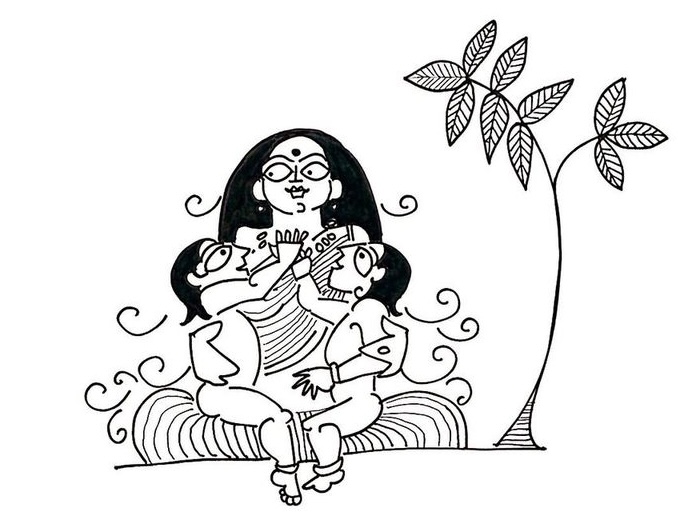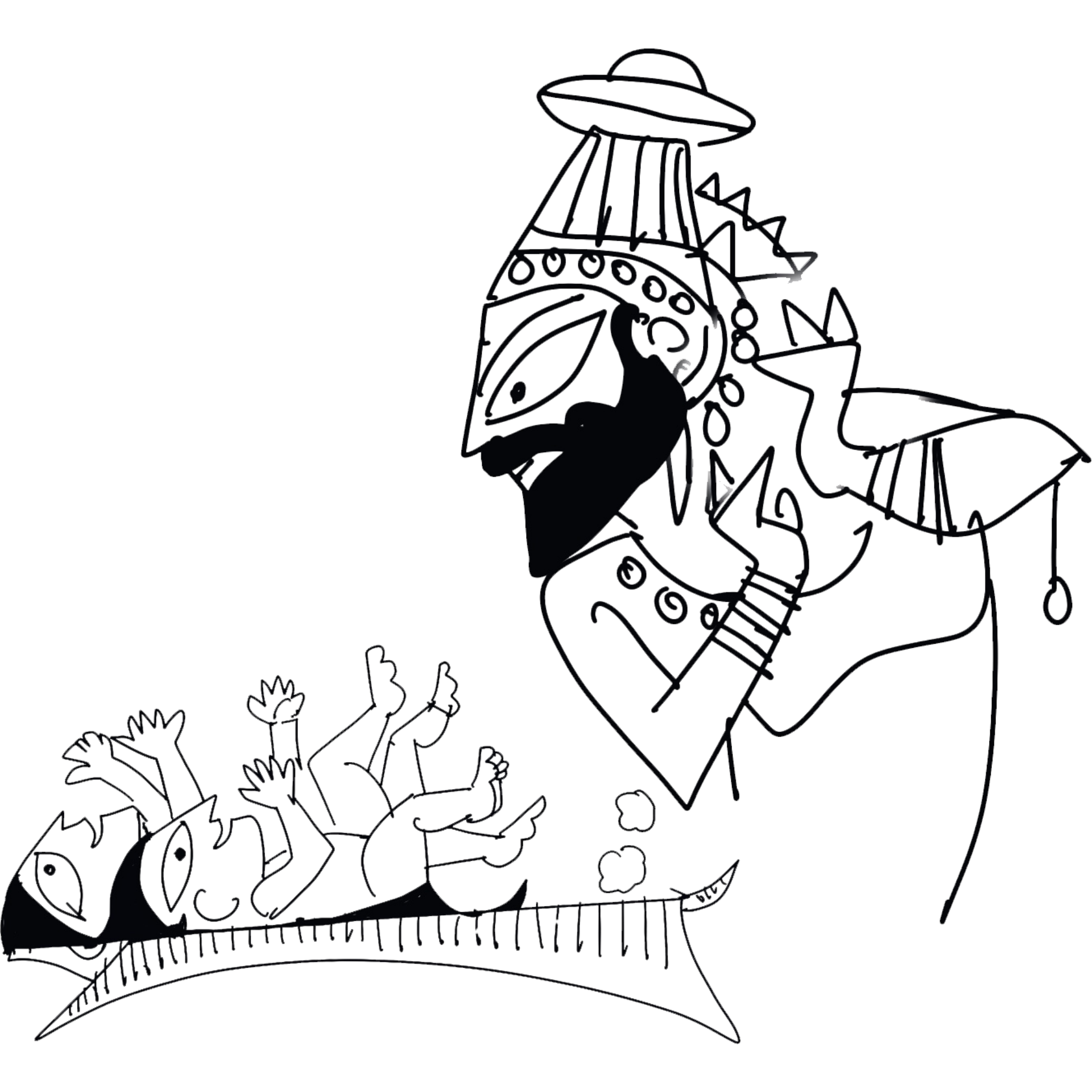
One day, King Shantanu stumbles upon two abandoned babies on the forest floor: a boy and a girl. He adopts them, names them Kripa and Kripi, and raises them. They are children of a tapasvi (fire-ascetic) named Saradvan and an apsara (water-nymph) named Janapadi. Mahabharata thus informs us of children abandoned by both father and mother but adopted by a single man. Kripa later becomes a renowned martial arts teacher, of the Kuru princes, while Kripi marries Drona, another martial arts master.
Mahabharata is the first epic to tell stories of the conflict between tapasvis and apsaras. The men abandon homes and live in the forest, shunning contact with all forms of pleasure, including women. The retained semen, following strict yogic practices, transforms into an inner fire (tapa) that grants these men magical powers (siddhi) with which they can change shape and size and even fly or walk on water. This makes Indra, king of gods, nervous. He fears they will topple him, so he sends the apsara to seduce them. Proof of her success is the production of a child. The semen is thus bound to earth through the child not raised up the spine to grant spiritual powers.
Who takes responsibility for the child? The man or the woman? The failed ascetic or the successful nymph? The father or the mother? It is neither. The ascetic rejects the child, seeing it as proof of his failure. The nymph abandons it, for her role is seduction and pleasure, not motherhood. Thus, the baby is discarded — until another figure, often a single man, steps in to raise it. The ancient story challenges “modern” gender roles. It is a far more fluid imagination.
Neither father nor mother is condemned for abandoning the child. The narrative does not assign automatic “motherhood duties” to the woman, nor does it condemn the man for leaving. Instead, adoption by another man highlights that in the world of Mahabharata writers child-rearing is not solely women’s responsibility. Men can be caregivers too.
The famous story of Vishwamitra and Menaka follows the same pattern: their child, Shakuntala, is abandoned and later raised by another sage, Kanva. In Buddhist and Jain narratives, too, men walk away from wives and children for spiritual quests. But the women stay back and take care of the household. The Buddha abandons Yashodhara and Rahula to seek answers to life’s suffering. This is celebrated as noble renunciation and even justified. By contrast, women who leave children behind are usually stigmatised. This makes the Mahabharata story very unique and different. Here, the responsibility of raising the child is not given to women. There is an acknowledgement of women’s freedom. Apsara embodies the courtesan, women who were tied to no man, and were not expected to be wives or mothers. They gave pleasure. That was their role. They were not home makers. But they were within prescribed social roles, celestial temptresses.
Ancient Indian lore does include tales of women who reject domestic roles. Many poet-saints of India like Lal Ded of Kashmir and Akka Mahadevi of Karnataka renounced marriage and motherhood to pursue spirituality. They refused to be wives, mothers, daughters, sisters. They are remembered because they were on a spiritual quest. Would they be forgiven if they abandoned husbands, sons and daughters in the pursuit of a career?