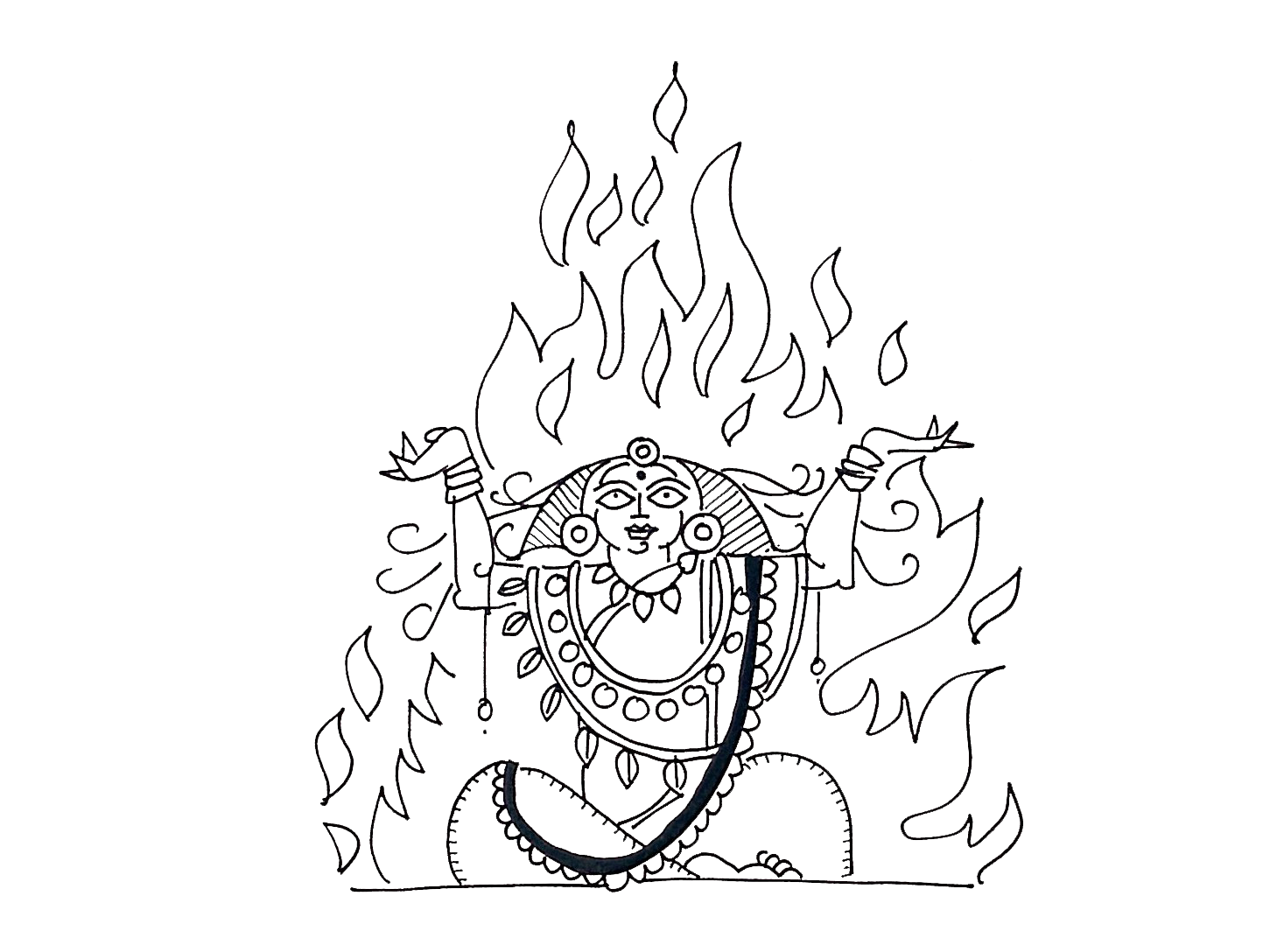
As per popular understanding, Ram asks Sita to go through the fire-trial to prove her chastity. But in the early versions of the Sanskrit epic it is not so. After killing Ravana and releasing Sita, Ram refuses to accept her as queen stating her reputation is soiled and so she cannot be his queen. She is free to go wherever she wishes, marry whoever she wants. Sita is understandably appalled and orders Lakshman to collect wood and light a pyre. She walks in. But is rescued by Agni, the god of fire, who declares her chastity. Some scholars believe this story to be an interpolation. For when Sita returns, the gossip happens nevertheless.
A similar story of chaste wives being questioned for their faithfulness, and being neglected by husbands, is also found in Buddhist Shambula Jataka. In Shiva Purana, Sati is a Brahmin’s daughter, who is upset that her father insults her mendicant ash-smeared husband and so she jumps into the Vedic fire altar and kills herself. In some versions of the story, she becomes the offering that is otherwise denied to Shiva. In others, Agni refuses to burn her so she creates her own fire to burn herself.
In Mahabharata, we are told that when Krishna dies, Rukmini and Jambavati, along with other junior wives, perform sati, while Satyabhama takes refuge in the forest as an ascetic. This is an obvious interpolation because the Kaurava widows do not commit sati. In folk narrations from Tamil Nadu, Draupadi after the war walks through fire to purify herself and prove her purity. She invites Kaurava widows to do the same. They are burnt alive, and join their husbands in paradise.
The popular story of Madri committing sati is also a later invention. The epic has two versions of Madri’s tale. In one, the later one, she commits sati out of guilt that her husband, Pandu, died when he touched her erotically, thus succumbing to a curse. In the earlier one, both die when Pandu touches her. They are both cremated by the orphan Pandavas.
It is a known fact that Vedic literature has absolutely no reference to the practice of burning widows. This practice started appearing in India roughly around 500 AD. The practice started to wane after the arrival of British rule, following fierce condemnation by social reformers and new laws. By Indian law, any glamorisation of the practice of sati—widow burning—is prohibited. While some have argued that these sati practices were a means by which women protected themselves from being violated by invaders, the fact remains that sati stones began to appear in almost every corner of India, at least five centuries before the rise of the Islamic period of India.
When one reads medieval folk epics, especially regional epics of warrior communities composed around the 15th century AD, one finds a great deal of valorisation of women who burn themselves on their husbands’ funeral pyres. Rajput epics like Alha Udal inform us how Prithviraj Chauhan’s daughter, Bela, performs sati after her husband, Brahmanand, is killed in battle. In one version, nobody wants to light the fire—people do not want her to burn herself alive and refuse to offer fire to the pile of wood. So, she creates her fire by unbinding her hair.
According to 19th-century records of colonial administrators, Holi was celebrated in the Bundelkhand area to remind the world of how Sita survived the Agni Pariksha (trial by fire). The fire is burned on the previous night to commemorate the Agni Pariksha, and the next day, people celebrate with water and colours because she successfully survived the fire trial. In another folklore, we are told that Mandodari approached Ram, and he blessed her, saying she would never become a widow. He did not realise that he was blessing the wife of Ravana, whom he had just killed in war. According to belief, a woman is not considered a widow until her husband has been fully cremated. Therefore, Ram instructed Hanuman to keep throwing wood into Ravana’s funeral pyre for all eternity so that it would continue burning and Mandodari would never be declared a widow. This version is largely unknown today. In fact, according to the Valmiki Ramayana, Mandodari married Vibhishana, who became the king of Lanka, a detail rarely told in modern retellings of the tale.
The oldest versions of the Ramayana have absolutely no references to sati. However, around the 14th century, the Telugu Ramayana refers to Indrajit’s wife, Sulochana (also known as Pramila in Marathi versions). She travels from Lanka, approaches Ram, and begs him to return her husband’s head so that she can cremate him and die alongside him, burning herself on his pyre. This story of Sulochana is immortalised in Michael Madhusudan Dutt’s work, Meghnad Badh Kavya, and is also one of the earliest stories of sati depicted in Indian cinema.