
Speaking Tree, Times of India, 24th October 1998.
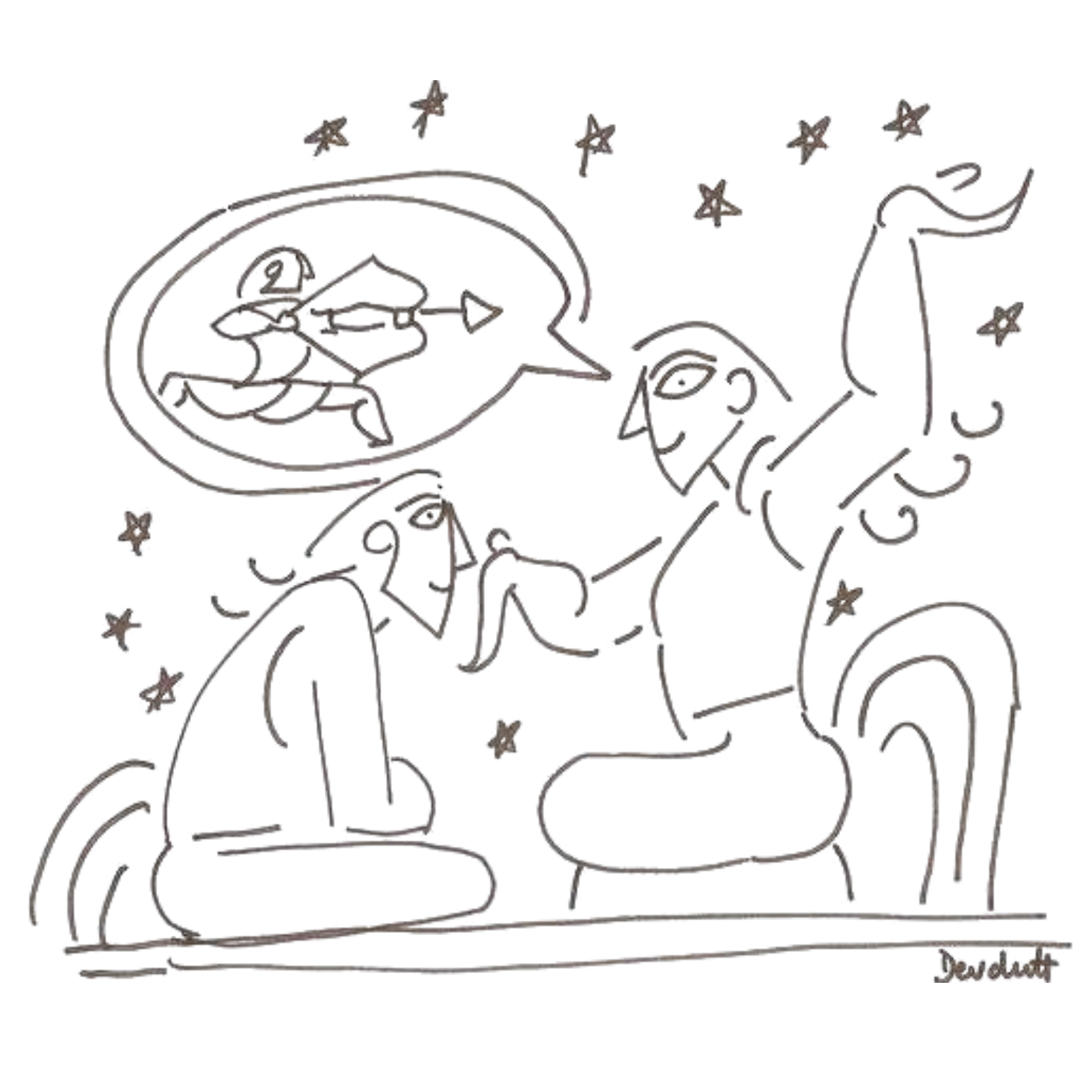
“How do you worship the lord?” asked the master.
“By renouncing the world and fixing my mind on Him,” replied the first student.
“By appreciating worldly beauty and bounty,” replied the second.
The master smiled and embraced the second student for he had understood the essence of pushti marga.
Pushti marga — realisation of the divine by acknowledging divine grace — forms the foundation of a Vaishnava cult patronised mainly by the trading communities of Gujarat and Rajasthan. This marga attributes a personality to the divine godhead. That personality — Shrinathji — is enshrined in a haveli at Nathadvara near Udaipur.
To the believer, the idol of Srinathji is svarupa, the living image of the Lord, to be lavished with offerings of raga, bhoga and shringara – music, food and adornment. Each day, priests toil lovingly to make sure the Lord wants for nothing. They wake him up to the tune of gentle music, bathe him with perfumed water, feed him the choicest delicacies and bedeck him in rich robes for festivals and feasts. Such indulgences befit Srinathji, ‘the lord of fortune’.
He is Vishnu, the celestial patron of worldly life. He is Krishna, the divine partaker of material delight. With his upraised arm, Srinathji holds up the cosmic mountain Govardhana to shield his devotees from universal sorrow; with his angular eyes, he beckons all to enjoy, without restraint, the gift of life. World-affirmation has always been at the heart of Vaishnava philosophy.
Traditionally, however, Vaishnava teachers have insisted on tempering all worldly deeds with devotion (bhakti), detachment (karma) and discernment (gyan). For, as they explain, the world is merely an illusion, a dream that helps one realise the divine. Vallabhacharya, an inspired mystic of the fifteenth century, did not accept this cheerless interpretation of maya. To him samsara was not as an intangible mirage. It was Krishna’s work-of-art inspired by Radha’s beauty. How could anyone distance oneself from this god-given splendour, he wondered.
Vallabha hailed from a family of Sri Vaishnava Telugu brahmins and he prescribed to the belief that Vishnu’s consort Sri, who is the bestower of worldly wealth and fortune, is the medium through which the lord can be be realised. He considered Shankara’s interpretation of the Vedanta as kevala advaita, mere monism, because it attempted to dissociate the tangible world from the Absolute. Vallabha called his interpretation suddha advaita, pure monism, according to which the tangible world is the Absolute. Unmanifest, the Brahman was lonely and joyless. And so it manifested itself as the colourful cosmos, the rangabhoomi. The abundance of the world is thus an expression of divine delight. He who appreciates this — the connoisseur, the shaukeen — is a true bhakta.
At the height of his intellectual evolution, Vallabha came upon the idol of Srinathji atop the legendary Mount Govardhana in Vrajabhoomi. The idol became the concrete manifestation of his philopophy. He enshrined the idol in a temple while his eldest son Vittalnath established elaborate rituals that humanized the deity and made him more accessible to the masses. Thanks largely to Vitthalnathji’s efforts, Srinathji ‘wakes up’, ‘eats’, ‘plays’, ‘grazes cattle’, ‘holds court’ and even needs be protected from the ‘evil eye’. The highly refined rituals of pushti marga have played an important role in consolidating the cult. Through them the devotees, who barely get a glimpse of the lord during the eight daily darshans, get the oppurtunity to get in touch with the manifested Unmanifest.
In the seventeenth century, in the midst of religious intolerance, the idol of Srinathji had to be moved from the banks of Yamuna to the deserts of Rajasthan, to be housed not in a temple but in the haveli, protected by Rajput warlords. The haveli and the village around it became known as Nathadvara, portal of the Lord. To this day merchants and artists go there seeking refuge in the grace of Shrinath: lord of the goddess of affluence and abundance.